| |
Current Research Projects
Language and Embodied Interaction in the Family
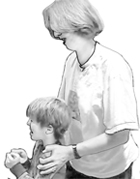
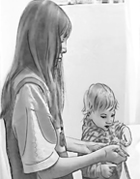
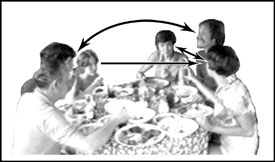
As a core faculty working with the Center for Everyday Lives of Families I became interested in developing new ways of studying multimodal human interaction in the context of the family. My concerns include how working parents as caregivers 1) accomplish the work of getting things done in the family (2) cultivate “family culture” in the midst of everyday talk (considering forms of socialization for competition as well as for creativity). I am interested in how parents structure opportunities for their children’s social, cognitive, and emotional development through their joint participation in mundane daily activities. Alternative participation frameworks that are constructed by families afford different ways of sustaining focused interaction, gearing into what someone has said, and displaying to each other how participants are aligned within the activity frame, considering turn structures, intonation contours, and body postures. Different types of trajectories develop in light of the forms of joint attention and sustained engagement that are established across a range of settings, including the car. In collaboration with a Swedish CELF researcher, Asta Cekaite, Charles Goodwin and I have developed a perspective for the analysis of emotion that focuses on how emotion is organized as social practice within ongoing human interaction. We view the act of stance taking as intrinsically multimodal and multiparty-- built through the coordinated activities of separate individuals in the midst of mundane activity. By viewing emotion as multimodal stance display, the analysis of emotion can be transformed from the study of events lodged within individuals to the investigation of changing displays of embodied actors within sequences of situated interaction
Social Organization in Children's Peer Groups: Ethnographic Analysis of Language Practices on the Playground
One
of my current research projects examines forms of children's informal
social learning across peer-controlled settings on the playground.
A principal concern of mine has been how, in the midst of interaction
with their peers, children elaborate and dispute their notions about
ethnicity, social class, and gender-appropriate behavior, as they
play or work together and sanction those who violate group norms
This fieldwork,
situated in a Los Angeles elementary school with children of mixed
ethnicities and social classes, has involved following a group of
children over three years as they moved from fourth to sixth grade.
In all over
80 hours of audio and video taped interaction were recorded while
children ate lunch, played at recess, and interacted in the classroom.
During
play (and outside of teachers' awareness) children decide who is
to be included or excluded within their playgroup; through their
language
choices children propose forms of inclusiveness or, alternatively,
differentiation among players. Through forms of ridicule such as
ritual insults, storytelling, and directives, children socialize
one another
regarding in- and out-group membership and notions of social class.
Most psychological studies of children's friendships and "relational
aggression" are based on interview data; subsequently, though
we know much about how children report incidents to researchers,
we know little about how they conduct themselves in the midst of
such
episodes. I feel it is important to document ethnographically the
lived practices that children use to build their social worlds, as
within
interaction members of a peer group collaboratively establish their
own perspectives on how relevant events are to be interpreted.
Papers associated with this include:
- Building Power Asymmetries in Girls' Interactions (2002)
- The Relevance of Gender, Ethnicity and Class in Children's Peer Interaction (2003)
- Organizing Participation in Cross-Sex Jump Rope: Situating Gender Differences within Longitudinal Studies of Activities (2001)
- Peer Language Socialization (with A. Kyratzis) (2011)
- The Hidden Life of Girls: Games of Stance, Status, and Exclusion (2006)
- He-Said-She-Said: Talk as Social Organization among Black Children (1990)
- Engendering Children's Play: Person Reference in Children's Conflictual Interaction. (2011)
- "Whatever (Neck Roll, Eye Roll, Teeth Suck)": The Situated Coproduction of Social Categories and Identities through Stancetaking and Transmodal Stylization (with H. S. Alim) (2010)
Embodied Language Games
A second current research project of mine
involves a comparative study of the game and play activities of diverse
groups of fifth grade children:
(1) a peer group that includes primarily second generation Central
American and Mexican bilingual Spanish/English speakers and three
Asian girls in a working class area of downtown Los Angeles, in Pico
Union/Koreatown,
(2) an ESL class in Columbia, South Carolina, which includes children
from Saudi Arabia, Vietnam, China, Mexico, Puerto Rico, Korean
and Azerbeijan, (3)African American children of migrant farm workers
in
rural Ridge Spring, South Carolina. In this more recent work I
have investigated how children in Latino and multi- ethnic groups
of different
social classes develop forms of negotiational abilities (including
forms of logical proof) and organizational skills in the midst
of spontaneous play on the playground (see audio/video sample of
data). Building on
Piaget's work on The Moral Judgment of the Child, social scientists
have made the claim that girls generally are less concerned with
making and arguing about rules than boys. My work has provided important
challenges
to many of the stereotypes about gender, ethnicity, and interactive
competence. Most studies of moral development in psychological
anthropology and throughout the social sciences have relied on interviews
and questionnaires,
conducted in laboratory settings, viewing values located within
the individual (as presented in talk to the anthropologist) more
important
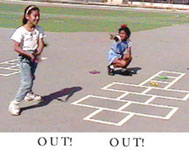
than interactive practice. My work finds that arguments are made
not through talk alone, but through the use of the body in conjunction
with other semiotic resources -- for example, graphic representations
such as a painted hop scotch grid.
Language in the Workplace
Another
strand of my research deals with language in the work place.
During 1989-1991
I worked on a project with five other anthropologists
at Xerox Palo Alto Research Center studying the social organization
of work practice at the San José International Airport. Our
methods involved a combination of participant observation, interviewing,
and analysis of audiotaped and videotaped interaction (over 120 hours
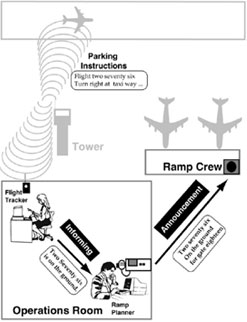
of tape). In these materials we developed new ways of analyzing the
coordination of work activity as it is mediated by technology in multiple,
distributed participation frameworks. Unique to this research is the
analysis of how documents are integral features of the communication
process. A distinctive characteristic of work at the airport is the
simultaneous articulation of multiple streams of activity. The involvement
of a single person in multiple information sources at the same time
is something that requires considerable expansion of Goffman's notion
of the" social situation. "
Dealing with the complexity of this work setting required not only
new conceptual frameworks, but also new ethnographic methods for capturing
in visual form both distributed action and orientation to relevant
documents. At points seven cameras were used to record simultaneous
activity in different work stations throughout the airport. One goal
of the project was to make our observations (and materials) available
to colleagues for teaching and further research, as well as to researchers
in disciplines who actually have power over the setting we investigated,
including architects and systems designers. We also wanted to make
our analysis accessible to the people whose work practice was investigated,
and could be impacted by our study. To this end we filmed, narrated,
and edited a 60 minute videotape entitled The Workplace Project: Designing
for Diversity and Change, which documents and analyzes work practice
in several key centers for coordination at the San Jose, CA airport.
Participation
My
involvement with the Workplace Project enabled me to develop new
ways of presenting
data visually. I have also been able to expand existing
concepts of "participation" (see paper on Participation),
which almost always focuses on speaker-centered talk to studies of
embodiment and stance in ordinary dinner-time conversation and storytelling.
I am concerned that descriptions of talk-in-interaction include not
only talk, but also paralinguistic features of speech, including not
only intonation but also the types of stances and positionings that
our bodies take up in the midst of communicative activity. My paper "Byplay" discusses
new ways of thinking about participation in story telling, illustrating
the active ways in which hearers can provide playful commentary on
ongoing talk in its midst. "Producing Sense with Nonsense Syllables" provides
analysis of the very active coparticipation in storytelling possible
by a man with a language disorder, aphasia. Though the aphasic man
possesses only a limited repertoire of semantic resources, intersubjectivity
is possible because sequential structures allow him to ratify the
correctness of what is being said by others, responding to family
members who have
shared his experiences and act as his voice. Rather than viewing
aphasia from the perspective that focuses on the isolated individual,
I examine
how the social group that the injured individual is embedded within
adapts to the new demands posed in the ongoing task of making meaning
together. Rather than locating meaning or language within the production
capabilities of a single speaker, I argue that we must investigate
the participation frameworks within which talk emerges, and is given
shape.
|
|