
 |
P. Jeffrey Brantingham
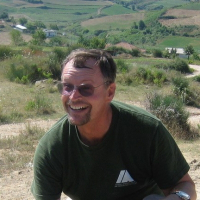
P. Jeffrey Brantingham, a Paleolithic archaeologist interested in the evolution of modern human behavior who is involved in field projects in China, Mongolia, and Tibet, is a new Assistant Professor in the Department of Anthropology.
How did you get interested in
archaeology?
My undergraduate training was in anthropology at the University of British Columbia, Canada (B.A., 1993). I gained my first archaeological field experience on the Northwest Coast. After spending a year in China for language studies, I moved in 1994 to the University of Arizona, Tucson, to work under Dr. John W. Olsen. I received my Ph.D. in 1999. Prior to joining the Department of Anthropology at UCLA, I was a postdoctoral fellow at the Santa Fe Institute in Santa Fe, New Mexico, where I conducted research on human behavioral evolution using techniques of computer simulation.
In what fieldwork projects are you involved?
I am involved in active field projects in Mongolia, as part of the Joint Mongolia-Russian-American Archaeological expedition, and in northwest China, as part of the Tengger Desert Project. Both projects are aimed at understanding early human adaptations in cold desert environments. I also lead the Tibet Paleolithic Project, sponsored by the US National Science Foundation, which is concerned with understanding human colonization of the Tibet Plateau, one of the most extreme terrestrial environments on the planet. In all of my research I draw heavily on models from theoretical biology and ecology and frequently use computer simulation as a tool for developing archaeological hypotheses.
What is your teaching schedule?
In upcoming quarters, I will be teaching the introduction to archaeology course, an
upper division course on paleolithic archaeology, and a graduate seminar on geochronology.
|
 |
Monica P. Smith
An Assistant Professor in the Department of Anthropology, Monica P. Smith (Ph.D., University of Michigan, 1997; M.A., UCLA, 1988) first became involved in archaeology in the first year of the master's program at UCLA. Originally pursuing a degree in Latin, she wanted to see how that language study could be used for archaeology, becoming interested in other types of field research and geographic areas and expanding her interests from the Roman period to South Asia.
Can you tell us about your fieldwork and research interests?
Although my principal region of interest is South Asia (India and Bangladesh), Iıve been fortunate in having a chance to do fieldwork in a variety of different areas, from Madagascar and Egypt to the American Southwest. Iıve written papers on a variety of subjects that may not initially seem to have much of a thematic link, such as the nineteenth-century shepherds of northern New Mexico and the development of urban centers in South Asia in the early centuries AD. But these share a thread of investigation: the link of parts to a whole and how local manifestations are connected to, influenced by, and different from the intentions of large state-level organizations. In the American Southwest, history tells us that the railroad made people prosperous: we have stories of instantly wealthy miners dining on oysters many hundreds of kilometers from the sea, as well as the development of individual empires by wealthy industrialists. Archaeology gives us a chance to see the small acts and artifacts that tell us how the system was working from the perspective of daily lives at the margins of the system; when we look at shepherds and herding camps, they are living with very few material possessions and participate only occasionally in the benefits of new economies. The integration of different social and economic activities also frames my current research work in South Asia. Iım directing a project of survey and mapping at the ancient site of Sisupalgarh in eastern India, a larger walled city of the early centuries AD. Iıve also been working with a large collaborative French-Bangladeshi archaeological project at the site of Mahasthangarh in Bangladesh. Cities like these were a focus of investment in labor and time not only for the central ruler but also for the many hundreds of ordinary residents. The construction of a wall may be envisioned by one person and coordinated by a small group of managers, but none of those ideas can be put into place without the labor and participation of those who do the actual work of moving earth and making bricks. They also gain a lot from those monumental structures: protection from floods and enemies, as well as the marker of an urban ³container² that identifies them as city-dwellers. The sense of belonging that comes from sharing symbols and obligations shouldnıt be underestimated. Looking at ordinary goods to see how cities were built from the bottom up rather than the top down offers a compelling perspective. I recently gathered a number of other archaeologists working on ancient cities to consider these ³bottom-up² perspectives, and Iım happy to say that our volume, entitled The Social Construction of Ancient Cities, will be published by Smithsonian Institution Press in 2003. We specifically wrote the book to be accessible to those working in modern urban studies so that they can see how cities over time have served as networks of opportunity for social and economic interaction. We used to think that cities were cold and alienating environments, but we see that people come pouring into modern cities and create intricate, well-connected lives a phenomenon that we can also see in ancient cities.
How do you approach teaching?
When I teach an introduction course, my aim is to get students to think about scientific approaches and methodologies in a way that benefits not only their understanding of ancient peoples but also how theories match data in scientific problems that we see in the newspapers every day, such as global climate change or how to cure and prevent diseases. On the other end of the learning spectrum, I enjoy preparing graduate students for lives as professional archaeologists by having them think through the process of data acquisition and how it will answer the compelling questions we have today about social groups at both the large-scale and the small-scale level. No matter how our theories change, the basic groundwork of archaeology remains the same: careful excavation, thorough survey work, data recording, and the preservation of specimens and information. In addition to courses on ancient urbanism and regional courses on South Asia, Iım looking forward to teaching a course on archaeology and national identity, as well as courses on comparative Old World and New World historical archaeology.
What brought you to UCLA?
Many things bring me to UCLAitıs a unique place for archaeological research in the United States. Itıs wonderful to have so many colleagues who also work in South Asia, as well as a strong core of archaeologists who work all over the world. Even if we have not visited each othersı geographic areas, we have all found points of comparison in shared methodological approaches and theoretical orientations. By working and teaching together, we can pass along those shared perspectives for the benefit of our students and our foreign colleagues. Iım looking forward to building up the South Asian Archaeology Laboratory and to the many opportunities for interaction in the Cotsen Institute of Archaeology.
|