
Stephen Aron
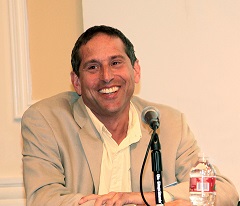
Stephen Aron
Professor Emeritus, President and CEO of the Autry Museum of the American West
Email: saron@history.ucla.edu
Office: 9351 Bunche Hall
Phone: 310-206-4603
Class WebsiteBiography
In July 2021, I will retire from UCLA and become the President and CEO of the Autry Museum of the American West.
A specialist in the history of frontiers, borderlands, and the American West, I have been on the faculty at UCLA since 1996. For many years, I held a concurrent appointment at the Autry Museum, first as the founding executive director and then chair of the Institute for the Study of the American West. In my dual roles as a professor and a museum professional, I sought to bridge the divide between “academic” and “public” history. For discussion of this bridge-building, see the video that I did for the American Historical Association’s “What I Do” series and the 2014 panels on history museums that I convened at the Smithsonian, which aired on CSPAN. To learn more about my approach to the West and my recent VERY SHORT INTRODUCTION for Oxford University Press, see my interview for UCLA Newsroom.
Current Project: Can We All Get Along: An Alternative History of the American Frontier.
Publications
Books
- The American West: A Very Short Introduction (New York: Oxford University Press, 2015).
- American Confluence: The Missouri Frontier from Borderland to Border State
(Bloomington: Indiana University Press, 2006; paperback edition, 2009). - Worlds Together, Worlds Apart: A History of the World from the Beginnings of Humankind to the Present, coauthored by J.Adelman, P. Brown, B. Elman, S. Kotkin, X. Liu, S. Marchand, H. Pitman, G. Prakash, B. Shaw, R. Tignor and M. Tsin (New York: W.W. Norton, 2002; 2cd edition, 2008; 3rd edition, 2011; 4th edition, 2014; concise edition, 2015).
- Trading Cultures: The Worlds of Western Merchants, co-edited with Jeremy Adelman (Turnhout, Belgium: Brepols for the Shelby Cullom Davis Center for Historical Studies, Princeton University, 2001).
- How the West Was Lost: The Transformation of Kentucky from Daniel Boone to Henry Clay
(Baltimore: Johns Hopkins University Press, 1996; paperback edition, 1999).
Selected Articles, Review Essays, and Book Chapters
- “Building Bridges” (co-authored with Virginia Scharff) in Gregory E. Smoak, ed., Western Land, Western Voices (Salt Lake City: University of Utah Press, forthcoming).
- “Once Upon a Time . . . in Ohio: David McCullough’s The Pioneers as History and Wishtory,” Journal of the Early Republic (forthcoming).
- “Expanding Horizons and Diversifying Skills: Transforming Graduate Curriculum,” (coauthored with Karen Wilson) in Leanne M. Horinko, Jordan M. Reed, and James M. Van Wyck, eds., The Reimagined PhD: Navigating 21st Century Humanities Education (New Brunswick, NJ: Rutgers University Press, 2021).
- “From Romance to Convergence,” in Amy Scott, ed., The Art of the West: Selected Works from the Autry Museum (Norman: University of Oklahoma Press, 2018), vii-xii.
- “The ‘We’ in West,” Western Historical Quarterly, 49 (Spring 2018): 1-15.
- “Violence et injustice dans l’Ouest américain au XIXe siècle,” Revue d’histoire du 19e siècle, 53 (2016/2): 139-145.
- “Interpreting the New History of the Old West,” in D.J. Waldie, Stephen Aron, Eden Lepucki, Tyler Green, Angela Bilog, Young Suh, and Katie Peterson,
- “Was the Great American West a Lie? An Inquiry Inspired by ‘Ed Ruscha and the Great American West’,” Zócalo Public Square (August 22, 2016): http://www.zocalopublicsquare.org/feature/was-the-great-american-west-a-lie/; republished as “The History of the American West Gets a Much-Needed Rewrite, Smithsonian.com (August 2016): http://www.smithsonianmag.com/history/history-american-west-gets-much-needed-rewrite-180960149/?no-cache.
- “Wishtory and History: An Illustrated Tour,” in Duane King, ed., Unlocking the History of the Americas: Helmerich Center for American Research (Tulsa: Thomas Gilcrease Institute of American History and Art, 2016), 10-25.
- “Historians and History Museums: A Report from the Annual Meeting Workshop,” Perspectives on History: The Newsmagazine of the American Historical Association, 52 (February 2014); for full video of this panel (from CSPAN), see http://series.c-span.org/History/Events/History-Museum-Directors/10737443851/
- “Putting Kentucky in its Place,” in James Klotter and Daniel Rowland, eds., Bluegrass Renaissance: The History and Culture of Central Kentucky, 1792-1852 (Lexington: University Press of Kentucky, 2012), 36-52.
- “All Quiet on the Turner Front,” Western History Association Newsletter (Fall 2011), 3-5.
- “Unmanifesting Destiny, Unclosing the Frontier,” Gilcrease Journal, 18 (Fall 2011), 4-21.
- “Frontiers, Borderlands, Wests,” in Eric Foner and Lisa McGirr, eds., American History Now (Philadelphia: Temple University Press for the American Historical Association, 2011), 263-286.
- “The French Connection” in Common-place (forthcoming) http://www.common-place.org/vol-11/no-01/reviews/aron.shtml.
- “Mavericks in the Malpai,” Convergence, 7 (Winter 2010), 14-19.
- “Convergence, California, and the Newest Western History,” California History, 86 (Autumn 2009), 4-13, 79-81.
- “Where Rivers Meet: Lessons from the ‘American Confluence’,” in Rivers and Settlements: International Comparisons (Taipei: Academia Sinica Press, 2009), 365-395.
- “Do Borderlands Still Have Borders?” Journal of the West, 47 (Summer 2008), 3-7.
- “Missions, Myth, and Memory in the Making of Modern Southern California,” Reviews in American History, 35 (March 2007), 83-88.
- “Jewish Los Angeles in the Making: The Early Pioneer Merchants and Bankers,” in David W. Epstein and Gladys Sturman, eds., Pioneer Jews of Los Angeles in the Nineteenth Century: A Special Archival Issue of Western States Jewish History, 38 (Spring/Summer 2006), 1-2.
- “Lewis and Clark and the Indians: The Rest of the Story,” Convergence, 3 (Winter 2006), 18-23.
- “Returning the West to the World,” OAH Magazine of History, 20 (March 2006), 53-60. (Reprinted in Gary W. Reichard and Ted Dickson, eds., America on the World Stage: A Global Approach to U.S. History (Urbana: University of Illinois Press for the Organization of American Historians, 2008), 85-98).
- “The Western Man in the Eastern Parlor: Alfred Bush and the Princeton Collections of Western Americana,” Princeton University Library Chronicle, 67 (Winter 2006), 221-224.
- “What’s West, What’s Next,” OAH Magazine of History, 19 (November 2005), 22-25.
- “The Meetings of Peoples and Empires at the Confluence of the Missouri, Ohio, and Mississippi Rivers,” in Bradley J. Parker and Lars Rodseth, eds., Untaming the Frontier in Anthropology, Archaeology, and History (Tucson: University of Arizona Press, 2005), 174-202.
- “The Afterlives of Lewis and Clark,” Southern California Quarterly, 87 (Spring 2005), 27-46; reprinted in Jacqueline Jones, ed., Best American History Essays, 2007 (New York: Palgrave for the Organization of American Historians, 2007).
- “The Western Forum: Of Past and Presentism,” Journal of the West, 43 (Summer 2004), 3-4.
- “Rediscovering Lewis and Clark,” Convergence, 1 (Summer 2004), 12-15.
- “The Making of the First American West and the Unmaking of Other Realms,” in William Deverell, ed., A Companion to the American West (Boston: Blackwell Publishers, 2004), 5-24.
- “The Next Western History,” Western Historical Quarterly, 33 (Autumn 2002), 337-341.
- “Continental Visions,” Common-place, 3 (October 2002).
- “Trading Culture: The Worlds of Western Merchants” (coauthored by Jeremy Adelman), in Jeremy Adelman and Stephen Aron, eds., Trading Cultures: The Worlds of Western Merchants (Turnhout, Belgium: Brepols for the Shelby Cullom Davis Center for Historical Studies, 2001), 1-6.
- “The American West Reprised, Revised, and Revived,” Reviews in American History, 28 (June 2000), 245-250.
- “Of Lively Exchanges and Larger Perspectives: Forum Essay: Responses to Borders and Borderlands” (coauthored by Jeremy Adelman), American Historical Review, 104 (October 1999), 1235-1239.
- “Daniel Boone and the Struggle for Independence on the Revolutionary Frontier,” in Ian Steele and Nancy Rhoden, eds., The Human Tradition in the American Revolution (Wilmington: Scholarly Resources, 1999), 139-157.
- “From Borderlands to Borders: Empires, Nation-States, and the Peoples in Between in North American History” (coauthored by Jeremy Adelman), American Historical Review, 104 (June 1999), 814-841; reprinted with chapters from Richard White’s The Middle Ground and Eric Wolf’s Europe and the People without History in Michael MacDonald, ed., “Contributions to Theory and Theme,” Cultural Configurations: Ethnic Relations and Power.
- “’The Poor Men to Starve’: The Lives and Times of Workingmen in Early Lexington,” in Craig Friend, ed., “The Buzzel about Kentuck”: Settling the Promised Land (Lexington: University Press of Kentucky, 1999), 174-193.
- “Renewing the History of Kentucky,” Register of the Kentucky Historical Society, 96 (Summer 1998), 307-314.
- “Pigs and Hunters: ‘Rights in the Woods’ on the Trans-Appalachian Frontier,” in Andrew Cayton and Fredrika Teute, eds., Contact Points: American Frontiers from the Mohawk Valley to the Mississippi, 1750-1830 (Chapel Hill: University of North Carolina Press for the Institute of Early American History and Culture, 1998), 175-204.
- “The Legacy of Daniel Boone: Three Generations of Boones and the History of Indian-White Relations,” Register of the Kentucky Historical Society, 95 (Summer 1997), 219-235.
- “’The West’ as America,” Perspectives: American Historical Association Newsletter, 34 (September 1996), 1, 7-10.
- “Lessons in Conquest: Towards a Greater Western History,” Pacific Historical Review, 63 (May 1994), 125-147; reprinted in Gordon Morris Bakken and Brenda Farrington, eds., The American West: Volume I: Where Is the West? (Hamden, CT: Garland Publishing, 2001), 79-102.
- “The Significance of the Frontier in the Transition to Capitalism,” in Christopher Clark, ed., “The Transition to Capitalism in America: A Panel Discussion,” The History Teacher, 27 (May 1994), 263-288.
- “The Significance of the Kentucky Frontier,” Register of the Kentucky Historical Society, 91 (Summer 1993), 298-323.
- “The Backcountry Frontier,” Reviews in American History, 21 (March 1993), 31-36.
- “Pioneers and Profiteers: Land Speculation and the Homestead Ethic in Frontier Kentucky,” Western Historical Quarterly, 23 (May 1992), 179-198.
Autry Insititute for the Study of the American West Publications
- Christopher Frayling, Once Upon a Time in Italy: The Westerns of Sergio Leone (New York: Harry N. Abrams, 2005); idem, Sergio Leone: Once Upon a Time in Italy (London: Thames & Hudson, 2005); idem, Il Etait une Fois en Italie: Les Westerns de Sergio Leone (Paris: Editions de La Martiniere, 2005).
- Amy Scott, ed., Yosemite: The Art of an American Icon (Berkeley: University of California Press, 2006).
- J. Michael Walker, All the Saints in the City of the Angels: Seeking the Soul of L.A. on Its Streets (Berkeley: Heyday Books, 2008).
- Carolyn Brucken and Virginia Scharff, Homelands: How Women Made the West (Berkely: University of California Press, 2010).
- Stephen White, Skydreamers: A Saga of Air and Space (Los Angeles: Autry National Center, 2010).
- Heather Dahl, Zevi Guttfreund, Karen Hoppes, Alli Jason-Fives, and Rachel Stutzman, Home Lands: A Teaching Unit, Grade Range 4-12 (National Center for History in the Schools, 2010).
- Joyce Szabo, Imprisoned Art, Complex Patronage: Plains Drawings by Howling Wolf and Zotom at the Autry National Center (Santa Fe: School for Advanced Research Press, 2011).
- David Wallace Adams and Christa DeLuzio, eds., On the Borders of Love and Power: Families and Kinship in the Intercultural American Southwest (Berkeley: University of California Press, 2012).
- Karen Wilson, ed., Jews and the Los Angeles Mosaic (Berkeley: University of California Press, 2013).
- Virginia Scharff, ed., Empire and Liberty: The Civil War in the West (Berekeley: University of California Press, 2015).
- Adam Arenson and Andrew Graybill, eds., Civil War Wests: Testing the Limits of the United States (University of California Press, 2015).
Convergence Magazine Issues (Editor in Chief)
- The Smoking Gun (Winter 2011).
- Sequeiros in Los Angeles: Censorship Defied/Sequeiros en Los Angeles: La Censura Desafiada (Fall 2010)
- The Primal Attraction (Winter 2010).
- The Sonic West (Winter 2009).
- “M” Is for Maverick (Fall 2008).
- Cowboys and Presidents (Spring/Summer 2008).
- Century Number Two: The Southwest Museum (Winter 2008).
- Chasing the Big Questions (Fall 2007).
- Gene Autry and the Twentieth-Century West (Summer 2007).
- Break the Glass (Winter/Spring 2007).
- Yosemite (Fall 2006).
- Cowboys (Spring/Summer 2006).
- Do You Know This Woman? (Winter 2006).
- How Women Made the West (Fall 2005).
- Whose West? (Spring/Summer 2005).
- The Selling of the Tipi (Winter 2005).
- What Lies Beneath (Fall 2004).
- The Great George Catlin Divide (Summer 2004).
- “A” Is for Convergence (Winter/Spring 2004).
Awards & Grants
- President, Western History Association, 2016-2017.
- Tadahisha Kuroda Lectures, Skidmore College, 2017.
- Society of American Historians, Elected, 2015.
- Peter and Margaret D’Angelo Chair in the Humanities, St. John’s University, 2015.
- Distinguished Speaker, Western History Association, 2013-.
- Annaley Naegle Redd Lecture in Western History, Brigham Young University, 2013.
- John L. Gray Lecture, Autry National Center, 2013.
- American Antiquarian Society, Elected, 2011.
- Robert Wilkins Lecture, University of North Dakota, 2011.
- John Francis Bannon Lecture, St. Louis University, 2011.
- Charles E. Freedeman Memorial Lecture, Binghamton University, 2010.
- C. Ruth and Calvin P. Horn Lecture, University of New Mexico, 2010.
- Ray A. Billington Lecture, Huntington Library, 2010.
- Travis-Merrick Lecture, University of Oklahoma, 2009.
- Veryl L. Riddle Lecture, Southeast Missouri State University, 2008.
- Fellow and Visiting Professor, Centre de Recherches d’Histoire Nord Américaine, Université de Paris 1 (Sorbonne), 2008
- Missouri History Book Award, State Historical Society of Missouri, 2007.
- Best Articles in American History, 2005/6, Organization of American Historians, 2006.
- Carl L. Wheat and Frank Wheat Award, Historical Society of Southern California, 2006.
- W.P. Whitsett Lecture, California State University, Northridge, 2004.
- Thomas D. Fulbright Lecture in American History, Washington University, 2003.
- Lowell Harrison Distinguished Lecture, Western Kentucky University, 2002.
- Distinguished Lecturer, Organization of American Historians, 2001-.
- National Society Daughters of Colonial Wars Teacher Award, 2000.
- Friends of Princeton Library Fellowship, 1999.
- Filson Fellowship, Filson Historical Society, 1999.
- Boone Lecture, Kentucky Historical Society, 1997.
- Louis Knott Koontz Memorial Award, American Historical Association-Pacific Coast Branch, 1995.
- Robert L. Middlekauff Fellow, The Huntington Library, 1993.
Graduate Students
Doctoral Commities — Chair
Jeremiah Sladeck (2020), “Padres Discontentos: Spanish Imperial Policy, Franciscan Decline, and the California Mission System, 1784-1803.”
Max Flomen (2018), “Cruel Embrace: War and Slavery in the Texas Borderlands, 1700-1840.”
Caroline Bunnell Harris (2016), “’Rivers of Living Waters’: The Movements and Mobilities of Holiness-Pentecostals, 1870-1910.”
Eric Saulnier (2016), “George Bancroft, Jacksonian Politics, and the United States’s Quest for a Western Empire.”
Daniel Lynch (2015), “Southern California Chivalry: The Convergence of Southerners and Californios in the Far Southwest, 1846-1866.”
Matthew Luckett (2014), “Honor among Thieves: Horse Stealing, State Building, and Culture in Lincoln County, Nebraska, 1860-1890.”
Michael Slaughter (2014), “Lessons on Freedom: Jefferson High School and Black Los Angeles, 1920-1950.”
Zevi Gutfreund (2013), “Language Education, Race, and the Remaking of American Citizenship in Los Angeles, 1900-1968.”
Karen Wilson (2011), “On the Cosmpopolitan Frontier: Jews and Social Networks in Nineteenth-Century Los Angeles.”
Erika Perez (2010), “Colonial Intimacies: Interethnic Kinship, Sexuality, and Marriage in Southern California, 1769-1885.”
Joshua Paddison (2008), “American Heathens: Race, Religion, and Reconstruction in California.” (Published under same title, University of California Press, 2012).
Jessie Schreier (2008), “A Different Shade of Freedom: Indians, African Americans and Race in the Choctaw Nation.”
Arthur Rolston (2006), “Constituting Capitalism: Constitutional Reform in Kentucky and Ohio from the Jacksonian Age to the Progressive Era.”
Wade Graham (2006), “Braided Waters: Environment, Economy, and Community in Molokai, Hawaii.”
Donald Michael Bottoms (2005), “An Aristocracy of Color: Race and Reconstruction in Post-Gold Rush California.” (Published as An Aristocracy of Color: Race and Reconstruction in California and the West, 1850-1890, University of Oklahoma Press, 2013).
Glenn Britton (2005), “Improving the ‘Middle Landscape’: Conservation and Social Change in Rural Southern Michigan, 1890-1940.”
Lawrence Culver (2004), “The Island, the Oasis, and the City: Santa Catalina, Palm Springs, Los Angeles, and Southern California’s Shaping of American Life and Leisure.” (Published as The Frontier of Leisure: Southern California and the Shaping of Modern America, Oxford University Press, 2010).
Cynthia Culver Prescott (2004), “Gender and Generation on the Pacific Slope Frontier” (Published as Gender and Generation on the Far Western Frontier, University of Arizona Press, 2007).
Lissa Wadewitz (2004), “The Nature of Borders: Salmon and Boundaries in the Puget Sound/Georgia Basin” (Published as The Nature of Borders: Salmon, Boundaries, and Bandits on the Salish Sea, University of Washington Press, 2012).
Allison Varzally (UCLA, 2002), “Ethnic Crossings: The Making of Non-White America in the Second Quarter of Twentieth-Century California” (Published as Making a Non-White America: Californians Coloring Outside Ethnic Lines, 1925-1955, University of California Press, 2008).
DOCTORAL COMMITTEES — MEMBER
Preston McBride (2020), “A Lethal Education: Institutionalized Negligence, Epidemiology, and Death in American Indian Boarding Schools, 1879-1934.”
Nicole Gilhuis (2020), “Atlantic Made: The French in Mi’kmaq Kinship, Daily Practice, and Family, 1600-1763.”
Citlali Sosa-Riddell (2020), “The Local Liberalisms of the Californios after the Mexican-American War: Race, Citizenship, and Transnational Intellectual Thought.”
Kristen Hillaire Glasgow (2019), “Charlotte Forten: Coming of Age as a Radical Teenage Abolitionist, 1854-1856.”
Elle Harvell (2019), “‘[B]etween fires’: Little Dixie, Missouri, During the American Civil War.”
Rhiannon Koehler (2018), “Visible Ink: Indigenous Editorial Cartoons and the Navajo-Hopi Land Dispute, 1964-1998.”
Max Baumgarten (2017), “Seaching for a Stake: The Scope of Jewish Politics in Los Angeles from Watts to Rodney King, 1965-1992.”
Christopher Bates (2016), “What They Fought For — The Men and Women of Reenactment: An Examination of Phenomenon of Reenactment and What It Can Tell Us about the Memory of the Civil War and the Place of History in Modern America.”
William Purdy, (2016), “Something New under the Los Angeles Sun: UCLA’s Early Years, 1919-1938.”
Andrew Gomez (2015), “Cubans and the Caribbean South: Race, Labor, and Cuban Identity in Southern Florida, 1868-1928.”
Su Kim Chung (2014), “‘We Seek to Be Patient’: Jeanne Wier and the Nevada Historical Society.”
Nicole Strathman (2013), “Through Native Lenses: American Indian Vernacular Photography and the Performance of Memories, 1890-1940.”
Heather Daly (2013), “American Indian Freedom Controversy: The Grassroots Political Resistance of Southern California Mission Indians, 1934-1960.”
Kathleen Williams (2012), “American Liberation Mythologies: Democracy and Domination in U.S. Visual Culture.”
Natalie Joy (2008), “Hydra’s Head: Fighting Slavery and Indian Removal in Antebellum America.”
Geneva Gano (2007), “Continent’s End: Literary Regionalism in the Modern West.”
Pete Alagona (2006), “Transforming Conservation: Endangered Species, Biodiversity, and the Political Economy of Science in California.”
Marne Campbell (2006), “Heaven’s Ghetto?: African Americans and Race in Los Angeles, 1850 to World War I.”
Susan Kim (2006), “Mr. Rogers’s Neighborhood: Religious Dissent in New London, 1674-1721.”
Shauna Mulvihill (2005), “A Tale of Two Suburbs, or, the Urban Fortunes of El Segundo and Hawthorne, California, 1905-1960.”
Suzanne Stauffer (2004), “Establishing a Recognized Social Order: Social and Cultural Factors in the Development of Utah Public Libraries, 1890-1920.”
Eric Altice (2003), “Foreign Missions and the Politics of Evangelical Culture: Civilization, Race and Evangelism, 1810-1860.”
John Bowes (2003), “Opportunity and Adversity: Indians and American Expansion in the Nineteenth-Century Trans-Mississippi West” (Published as Exiles and Pioneers: Eastern Indians in the Trans-Mississippi West by Cambridge University Press).
Cynthia Cumfer (2001), “‘The Idea of Mankind Is So Various’: An Intellectual History of Tennessee, 1768-1810” (Published as Separate Peoples, One Land: The Minds of Cherokees, Blacks, and Whites on the Tennessee Frontier by University of North Carolina Press).
Nathaniel Sheidley (1999), “Unruly Men: Indians, Settlers, and the Ethos of Frontier Patriarchy in the Upper Tennessee Watershed, 1763-1815.”
Gary Hewitt (1996), “Expansion and Improvement: Land, People and Politics in South Carolina and Georgia, 1690-1745.”
Darryl Peterkin (1995), “‘Lux, Libertas, and Learning”: The First State University and the Transformation of North Carolina, 1789-1816.”
Geoffrey Plank (1994), “The Culture of Conquest: The British Colonists and Nova Scotia, 1690-1759” (Published as An Unsettled Conquest: The British Campaign Against the Peoples of Acadia by University of Pennsyvania Press, 2001).
Cindi Alvitre, dissertation in progress.
Michael Richardson, dissertation in progress.